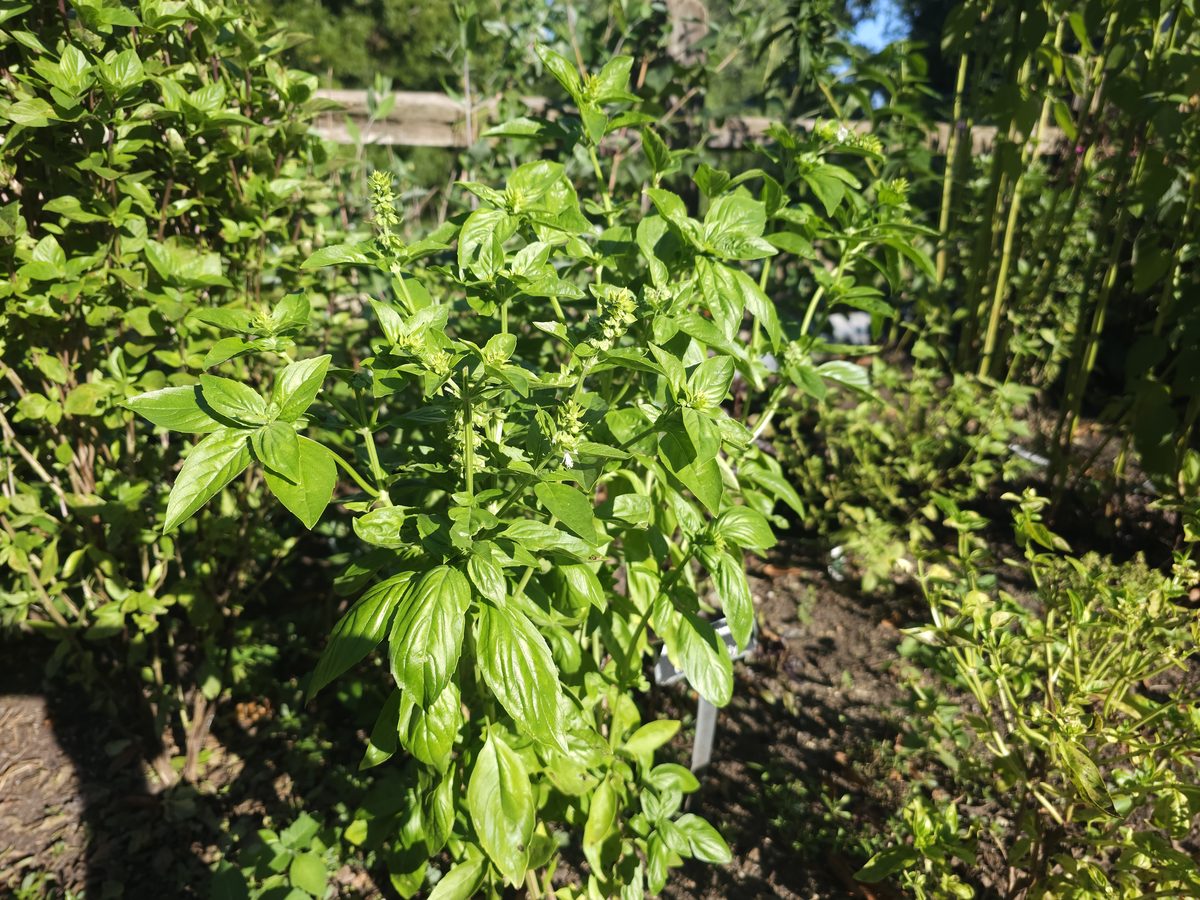
The one technique that matters: pinching
Basil grows as a single stem with a pair of leaves at each node. Left alone it will produce six or seven pairs and then throw a flower spike from the top, at which point leaf production stops and the leaves turn woody and harsh.
The fix is to cut the top off just above a node, removing the growing tip. The plant responds by pushing two new shoots from that node. Do it again and you get four. Do it once more and you have eight. This is the whole difference between a spindly supermarket plant and a bush you harvest from weekly.
Pinch early. The conventional mistake is waiting until the plant looks big enough to harvest. Cut at the third or fourth node while it is still small, and the plant will branch from there. Taking the top two node-pairs off early costs you a week and triples the eventual plant.
Warmth, light, and why it sulks
Basil is unhappy below about 15 °C (59 °F) — the leaves blacken and the plant stalls. Keep the reservoir at 20 °C (68 °F) if you can, and never put it somewhere that drops overnight. This is one of the few crops where the chiller is there to keep water warm rather than cool.
It wants strong light and plenty of it. A sunny windowsill is adequate for a pot on the sill; under it, plants will lean and stretch. Supplemental light for 12–14 hours gives a dense, thick-leaved plant.
Feeding: gentler than you think
Basil is not a heavy feeder and the fastest way to ruin a crop is to run it like a tomato. Keep EC low — 1.2–1.6 mS/cm is plenty — and pH around 6.0. High EC produces dark, thick, hard leaves with a harsher flavour and burns the leaf edges.
Change the reservoir every two to three weeks. Basil in a small reservoir will quietly exhaust the magnesium first, showing as yellowing between the veins on older leaves. When you see that, a change of solution fixes it faster than an additive.
Harvesting
Never strip a plant below a third of its height. Harvest from the top down, always cutting above a node so the plant branches again. A single cut should take no more than about a third of the foliage.
The best time is early morning, before the heat of the day, when the essential oil content is highest. Cut whole stems rather than picking leaves off one at a time — the stem is not worth using but cutting it is what triggers branching.
If a flower spike does form before you catch it, cut it off anyway. The plant will resume leaf production, though the leaves on the flowering stem itself will be tougher. For seed saving, letting one plant flower deliberately is worth doing — see the saving page.
What goes wrong
Yellowing between the veins on older leaves — magnesium deficiency, common in small reservoirs. Solution change, not a supplement.
Blackened, collapsed leaves at the bottom — cold. Nighttime temperature below 12 °C (54 °F) will do it.
Sudden wilting — check the air pump first and the water level second. In clay pebbles a saturated root zone with no oxygen will rot within two days.
Downy mildew — the yellowing on the upper leaf surface with grey fuzz underneath that spreads rapidly. It thrives on wet leaves and poor airflow in a still room. Remove affected leaves, increase airflow, and reduce water splashing onto foliage.